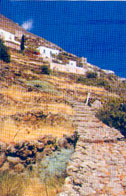
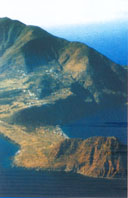
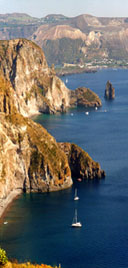
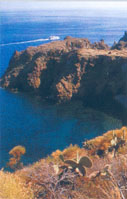
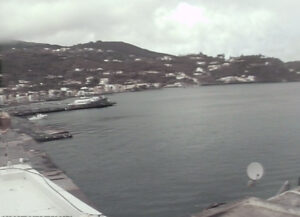
The Aeolian islands

Click on the name of the island for
further information
Questa immagine ha l'attributo alt vuoto; il nome del file è Alicudi-1.jpgALICUDI
It is the westernmost island of the archipelago. The ancient name Ericusa is due to the rich vegetation of heather, of which the island is covered. The heather is part of the history and life of the islanders, who have always used it to cover huts and, with the root, pipe stoves. Alicudi is a rounded cone that culminates with the Filo dell’Arpa relief and has an area of ​​5.2 sq km. The inhabitants, called alicudari, are about 140 and live in the only inhabited center (Alicudi porto), fishing and little agriculture. Of volcanic origin, the island is largely made up of the extinct volcano of Montagnola born about 150,000 years ago following effusive and explosive eruptions
Questa immagine ha l'attributo alt vuoto; il nome del file è Filicudi.jpgFILICUDI
Formerly called Phoenicusa (rich in ferns), together with Alicudi it is geologically the oldest of the Aeolian Islands. It has an area of ​​9.5 sq km and its highest point, the Fossa delle Felci, is at 773 meters. The inhabitants, called filicudari, are about 250, scattered in the three main inhabited centers: Filicudi porto, Pecorini a mare and Valle Chiesa. The conformation of the island is slightly oval and extends to the south-east in the promontory of Capo Graziano which is a small peninsula connected to the main part of Filicudi by a strip of land. The island is made up of the products of six volcanic centers. The oldest must have been located in the sea near the coast of Fili di Sciacca.
Questa immagine ha l'attributo alt vuoto; il nome del file è quattrocchi_sp.jpgLIPARI
It is the largest island of the Aeolian archipelago. It has an area of ​​37.6 square kilometers and is 24 nautical miles from the Sicilian coast. Its inhabitants, called Liparesi or Liparoti, are about 9000 and populate the hamlets of the island: Canneto, Acquacalda, Quattropani and Pianoconte. With the exception of Salina, all the other islands are administratively dependent on Lipari. Like all the Aeolian archipelago, Lipari has volcanic origin. The oldest part of the island is the western one where, between 160,000 and 134,000 years ago, 12 volcanic layers are identified, including the Timponi. This phase of intense eruptions was followed by a long pause in volcanic activity. In the second period, about 100 thousand years ago, the volcano of Monte S. Angelo was created. The volcanoes of the third period (40,000 and 8,000 years ago) erupted pumice, forming a series of domes, including Monte Guardia and Monte Giardina. After a long pause, the eruptive activity resumed in the north-eastern part with the launch of enormous quantities of pumice, which made up Monte Pelato, and with the emission of the obsidian flow of the Rocche Rosse (VII) century AD. C. Even in historical times there were eruptions of pumice which covered with a layer of very fine dust the most ancient archaeological levels in the Diana district and in the acropolis of the Castle.
Questa immagine ha l'attributo alt vuoto; il nome del file è Panarea-1.jpgPANAREA
Panarea, formerly called Hycesia, is the smallest island of the Aeolian archipelago. It has an area of ​​only 3.4 square kilometers and is 11.5 miles from Lipari. Its 280 inhabitants, called panarioti, live in three districts: Ditella, S. Pietro and Drauto. Panarea is framed by the nearby islets of Basiluzzo, Dattilo, Bottaro, Spinazzola and the rocks of Lisca Bianca, Lisca Nera, Panarelli and Formiche. Scholars believe that Panarea and the rocks and islets that surround it are the remains of an ancient underwater volcano partially submerged by the waters in the interglacial periods. In the currently emerged part it is possible to recognize a single volcano on whose flanks numerous secondary eruptive centers have been implanted.
Questa immagine ha l'attributo alt vuoto; il nome del file è salina-1.jpgSALINA
After Lipari, it is the second largest island of the archipelago: about 27 square kilometers in area. It is the highest of the 7 islands with the mountains “Fossa delle Felci” and “Monte dei Porri” also long-extinct volcanoes. From the presence of these two peaks its ancient name Didyme, which means Gemini, dates back. The current name derives from the presence of a small lake from which salt was extracted which was then used for the conservation of capers and fish. It is the second most populated island of the archipelago with about 2,300 inhabitants. It is divided into three autonomous municipalities: S. Marina, Malfa and Leni. The hamlets are called: Lingua, Rinella, Val Di Chiesa, Pollara and Torricella. In the territory of Salina there are traces of six volcanoes.
Questa immagine ha l'attributo alt vuoto; il nome del file è Stromboli-1.jpgSTROMBOLI
The farthest and most easterly of the Aeolian islands, Stromboli is about 22 miles from Lipari. The ancients called it Strongyle, the rotunda. It has an area of ​​12.6Kmq. with about 420 inhabitants, called Strombolani. Its active volcano is about 920 meters high above the sea and the seabed is very deep (1200 m.). The island is a volcano that emerges from the sea. The emerged part, in persistent activity for at least 2000 years, was formed mainly during two cycles of activity. An ancient cycle, consisting of eruptions of solid material and lava flows, which formed the entire eastern part of the island, and a more recent cycle, consisting mainly of lava flows, which formed the entire western half of the island.
Questa immagine ha l'attributo alt vuoto; il nome del file è vulcano.jpgVULCANO
The ancient Hiera (sacred), according to the Greeks home of the God of Fire Hephaestus, is the southernmost island of the Aeolian archipelago and is the closest to Sicily. It is separated from nearby Lipari by a canal about 1.6 km wide. Its surface is 21 sq km. From a geological point of view, the island is made up of 4 volcanoes: Lentia, Vulcano Piano, Fossa di Vulcano and Vulcanello. The only one to be considered still active is the Vulcano della Fossa. The volcanic activity of this island was known since ancient times to the Greeks and Romans, who were strongly impressed by it.
We use cookies to personalise content and ads, to provide social media features and to analyse our traffic. We also share information about your use of our site with our social media, advertising and analytics partners.
Cookies settings
Accept
Privacy & Cookie policy
Privacy & Cookies policy
Cookie name Active

Privacy Policy

What information do we collect?

We collect information from you when you register on our site or place an order. When ordering or registering on our site, as appropriate, you may be asked to enter your: name, e-mail address or mailing address.

What do we use your information for?

Any of the information we collect from you may be used in one of the following ways: To personalize your experience (your information helps us to better respond to your individual needs) To improve our website (we continually strive to improve our website offerings based on the information and feedback we receive from you) To improve customer service (your information helps us to more effectively respond to your customer service requests and support needs) To process transactions Your information, whether public or private, will not be sold, exchanged, transferred, or given to any other company for any reason whatsoever, without your consent, other than for the express purpose of delivering the purchased product or service requested. To administer a contest, promotion, survey or other site feature To send periodic emails The email address you provide for order processing, will only be used to send you information and updates pertaining to your order.

How do we protect your information?

We implement a variety of security measures to maintain the safety of your personal information when you place an order or enter, submit, or access your personal information. We offer the use of a secure server. All supplied sensitive/credit information is transmitted via Secure Socket Layer (SSL) technology and then encrypted into our Payment gateway providers database only to be accessible by those authorized with special access rights to such systems, and are required to?keep the information confidential. After a transaction, your private information (credit cards, social security numbers, financials, etc.) will not be kept on file for more than 60 days.

Do we use cookies?

Yes (Cookies are small files that a site or its service provider transfers to your computers hard drive through your Web browser (if you allow) that enables the sites or service providers systems to recognize your browser and capture and remember certain information We use cookies to help us remember and process the items in your shopping cart, understand and save your preferences for future visits, keep track of advertisements and compile aggregate data about site traffic and site interaction so that we can offer better site experiences and tools in the future. We may contract with third-party service providers to assist us in better understanding our site visitors. These service providers are not permitted to use the information collected on our behalf except to help us conduct and improve our business. If you prefer, you can choose to have your computer warn you each time a cookie is being sent, or you can choose to turn off all cookies via your browser settings. Like most websites, if you turn your cookies off, some of our services may not function properly. However, you can still place orders by contacting customer service. Google Analytics We use Google Analytics on our sites for anonymous reporting of site usage and for advertising on the site. If you would like to opt-out of Google Analytics monitoring your behaviour on our sites please use this link (https://tools.google.com/dlpage/gaoptout/)

Do we disclose any information to outside parties?

We do not sell, trade, or otherwise transfer to outside parties your personally identifiable information. This does not include trusted third parties who assist us in operating our website, conducting our business, or servicing you, so long as those parties agree to keep this information confidential. We may also release your information when we believe release is appropriate to comply with the law, enforce our site policies, or protect ours or others rights, property, or safety. However, non-personally identifiable visitor information may be provided to other parties for marketing, advertising, or other uses.

Registration

The minimum information we need to register you is your name, email address and a password. We will ask you more questions for different services, including sales promotions. Unless we say otherwise, you have to answer all the registration questions. We may also ask some other, voluntary questions during registration for certain services (for example, professional networks) so we can gain a clearer understanding of who you are. This also allows us to personalise services for you. To assist us in our marketing, in addition to the data that you provide to us if you register, we may also obtain data from trusted third parties to help us understand what you might be interested in. This ‘profiling’ information is produced from a variety of sources, including publicly available data (such as the electoral roll) or from sources such as surveys and polls where you have given your permission for your data to be shared. You can choose not to have such data shared with the Guardian from these sources by logging into your account and changing the settings in the privacy section. After you have registered, and with your permission, we may send you emails we think may interest you. Newsletters may be personalised based on what you have been reading on theguardian.com. At any time you can decide not to receive these emails and will be able to ‘unsubscribe’. Logging in using social networking credentials If you log-in to our sites using a Facebook log-in, you are granting permission to Facebook to share your user details with us. This will include your name, email address, date of birth and location which will then be used to form a Guardian identity. You can also use your picture from Facebook as part of your profile. This will also allow us and Facebook to share your, networks, user ID and any other information you choose to share according to your Facebook account settings. If you remove the Guardian app from your Facebook settings, we will no longer have access to this information. If you log-in to our sites using a Google log-in, you grant permission to Google to share your user details with us. This will include your name, email address, date of birth, sex and location which we will then use to form a Guardian identity. You may use your picture from Google as part of your profile. This also allows us to share your networks, user ID and any other information you choose to share according to your Google account settings. If you remove the Guardian from your Google settings, we will no longer have access to this information. If you log-in to our sites using a twitter log-in, we receive your avatar (the small picture that appears next to your tweets) and twitter username.

Children’s Online Privacy Protection Act Compliance

We are in compliance with the requirements of COPPA (Childrens Online Privacy Protection Act), we do not collect any information from anyone under 13 years of age. Our website, products and services are all directed to people who are at least 13 years old or older.

Updating your personal information

We offer a ‘My details’ page (also known as Dashboard), where you can update your personal information at any time, and change your marketing preferences. You can get to this page from most pages on the site – simply click on the ‘My details’ link at the top of the screen when you are signed in.

Online Privacy Policy Only

This online privacy policy applies only to information collected through our website and not to information collected offline.

Your Consent

By using our site, you consent to our privacy policy.

Changes to our Privacy Policy

If we decide to change our privacy policy, we will post those changes on this page.
Save settings
Cookies settings